
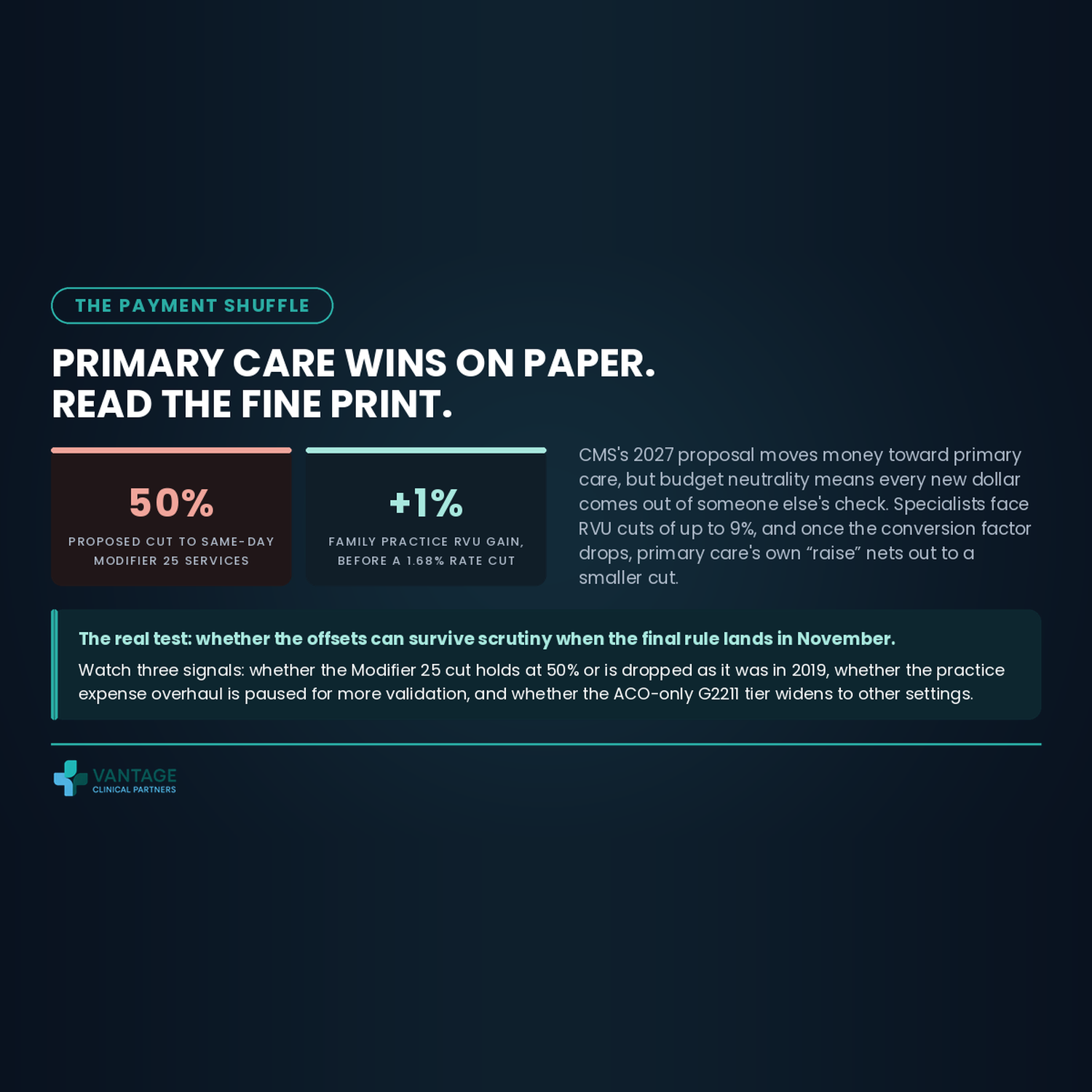
Primary Care Wins on Paper: The Fine Print in Medicare's 2027 Proposal
Inside Medicare's 2027 fee schedule: real gains for behavioral health (Collaborative Care up 20-40%) and a simplified G2211, paid for by contested offsets that hit dermatology, ENT, and orthopedics hardest. With even family medicine netting close to flat and key policies still unsettled, the final rule's treatment of Modifier 25, practice expense, and G2211 will decide who actually comes out ahead.
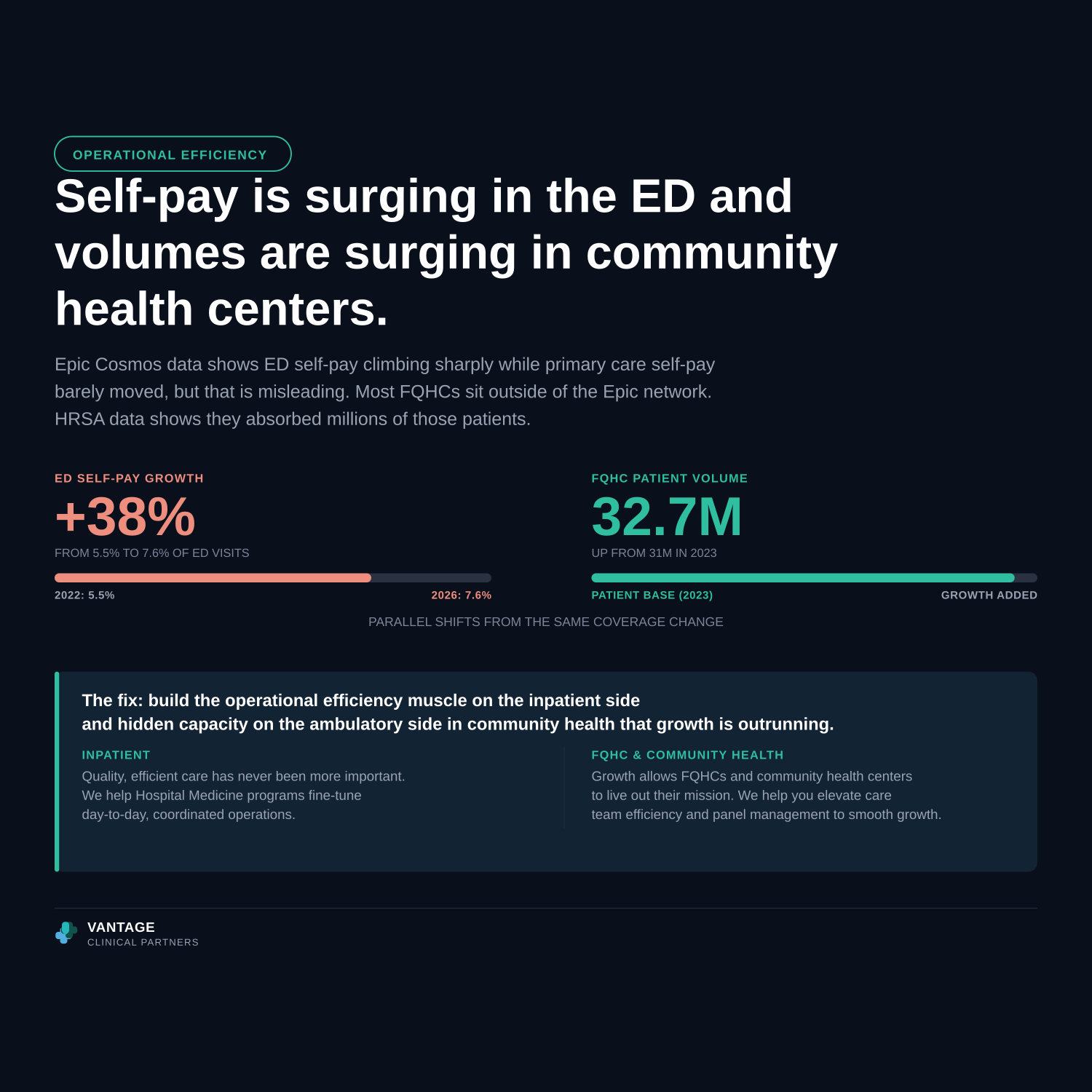
Efficiency Where It's Needed Most: What the Payor Mix Shift Means for Hospitals and Health Centers, Alike
Self-pay in the ED is up 38% since 2022. Medicaid enrollment fell over the same period. New Epic Cosmos data (550M+ encounters) shows self-pay climbing sharpest in the ED, while primary care barely moved. But that "stability" is hiding something: most FQHCs sit outside Epic's network. HRSA data shows they absorbed millions of the patients Medicaid left behind (31M → 32.7M patients, 2023–2025).

CMS Moratorium Treats a Symptom, Not the Disease
CMS's May 2026 moratorium on new hospice and home health enrollment is a justified response to documented fraud, but it treats a symptom rather than the underlying cause. The question we should be asking is why the hospice and home health sectors became so attractive to fraud and rapid, low-quality growth in the first place. The deeper problem starts long before a patient ever elects hospice.
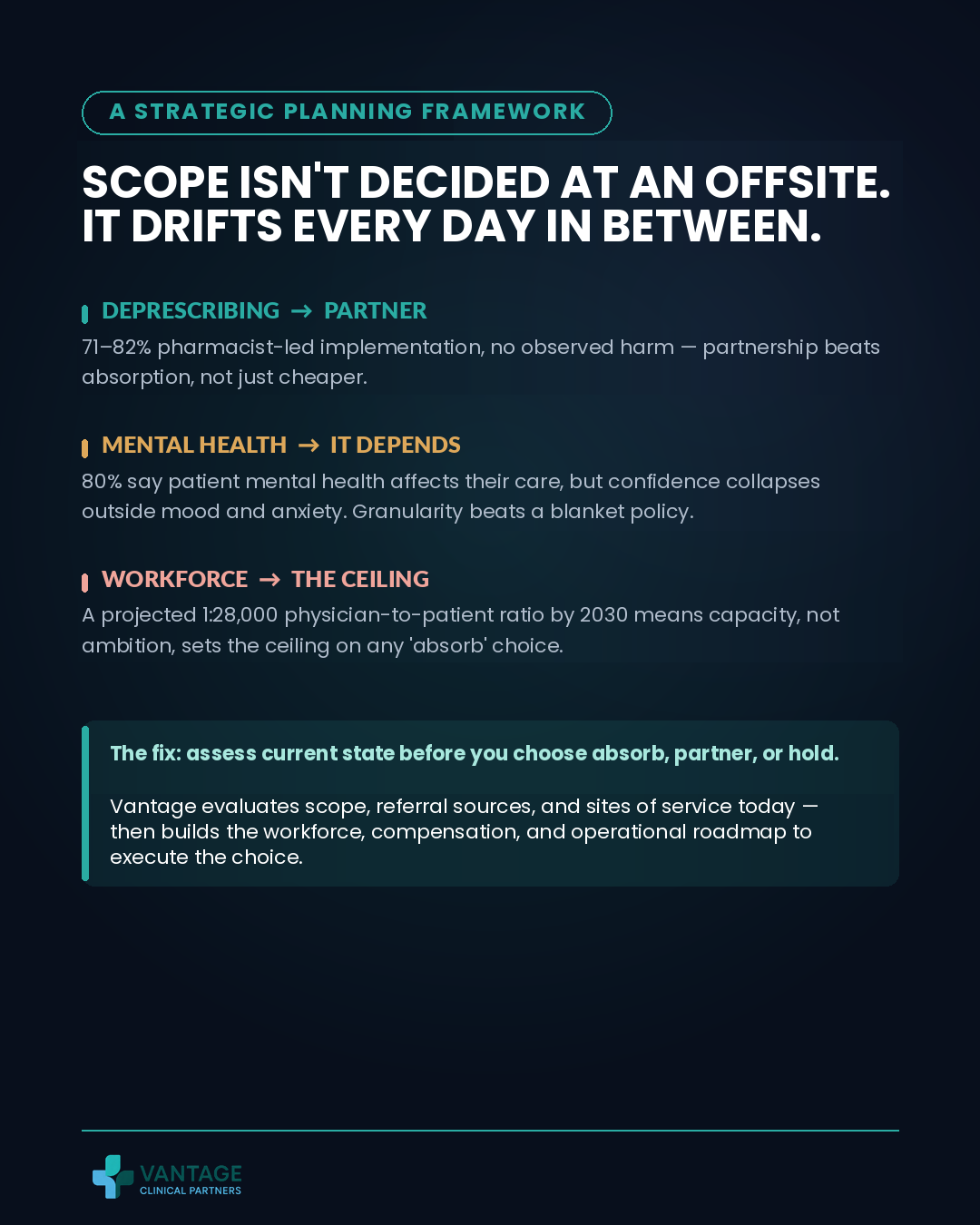
Insights Into Service Line Strategic Planning: Palliative Medicine’s Expanding scope is an identity Question
Strategic planning is often treated as an every-few-years capacity exercise. The scope pressures below are the argument for why it has to be routine. Scope drifts continuously — through referral patterns, individual clinician interests, and gaps elsewhere in the system — while formal planning happens episodically. The gap between those two clocks is where a service line could lose control of its own identity. Two current, real-world examples in Palliative Medicine show how fast that gap opens.

Strengthening the Broker - Client Relationship Through Direct Primary Care
For brokers evaluating how to bring more value to self-insured clients, Direct Primary Care — supported by the right advisory expertise — offers a model with a growing and substantive evidence base behind it. It is a way to bring clients a solution that delivers measurable financial outcomes, improves the health and experience of their workforce, and reinforces the broker's position as the trusted advisor their clients cannot afford to be without.

Solving the Bandwidth CHallenge with Specialized Implementation Support
Healthcare organizations often know what needs to change. The real challenge — and where so many initiatives stall — is how to make change actually stick. Dedicated strategy implementers create outsized value precisely at this intersection, and the evidence behind that value is compelling.

Meeting Patients where they work: Building the rural hospital-employer partnership model
Moving from a volume-based, reactive care model to a proactive, value-based population health approach generates savings through reduced emergency department crowding, lower inpatient utilization, and better managed chronic disease — outcomes that flow directly to the employer's bottom line and back to the hospital through stronger commercial payer relationships, reduced bad debt, and sustained community goodwill.

Rural Hospitals Have an Opportunity to Deepen Partnership with Local Employers
Three forces are converging on rural America at once: hospitals running out of financial runway, employers running out of patience with healthcare costs, and families watching deductibles climb 43% higher than a decade ago with no relief in sight. The hospitals that recognize this moment and act on it will strengthen the entire community.

The Maestro Model: Why Primary Care Needs Autonomy, Open Access, and an Operational Chassis Built to Match
The evidence is clear: when physicians and APPs are given the autonomy to lead, when scheduling architecture is designed for access, and when the operational environment supports rather than burdens the clinical team, outcomes improve and populations are better served.

More Than an Open Door: What It Takes to Keep FQHC Patients Connected to Care
For millions of Americans, a Federally Qualified Health Center (FQHC) is where they bring their children for well-child visits, manage diabetes or hypertension without fear of an unaffordable bill, and build a healthcare relationship grounded in trust. What patients want is straightforward: a provider who knows them, an appointment they can get to, and care that treats them with dignity.

Dynamic Tension as a Performance Engine for C-suites & Hospital Medicine Teams
Hospital C-suites & Hospital Medicine programs want the same things. High-quality care for every patient. An inpatient operation that moves efficiently. A team that is fully engaged, clinically excellent, and right-sized. Costs that reflect the value being generated. These are not competing priorities. They are a shared destination, and the dynamic tension between a hospital medicine group and the C-suite exists not because they disagree on where they are going, but because each sees a different set of obstacles standing between here and there.

$50 Billion for Rural Health: Where to Put It to Work
The Rural Health Transformation Program (RHTP) is $50 billion in federal investment directed at exactly the communities that need it most. For rural hospital leaders and health system executives who move quickly and invest strategically, it is the most significant opportunity to reshape rural care delivery in a generation.

The Coverage Illusion: Every Front Door to Your Health System Needs a Self-Pay Strategy — and Employers Are Already Building Their Own
As deductibles hit historic highs and Medicaid coverage erodes, insured patients are functionally uninsured for most of the year. Every access point in your care model — urgent care, primary care, employer clinics — must now price and package services for a patient who pays like a consumer, not a beneficiary.

Earlier Palliative Care Involvement is fundamental, human-centered care
There are very few interventions in all of healthcare that generate benefit across every stakeholder simultaneously. Palliative Care is one of them. What if the most powerful thing medicine could offer a seriously ill patient wasn't another treatment — but rather, clarity? Palliative Care is built on that premise. The evidence is unambiguous — patient’s values and goals are genuinely heard and woven into their care plan, clinicians experience less moral distress, and health systems reduce costly, avoidable utilization. This is not a nice-to-have service. It is a required staple of serious illness care.

High-Functioning Hospital Medicine Demands a High-Functioning System: How Hospital Administrators Unlock the Full Potential of Hospital Medicine
"The strength of the team is each individual member. The strength of each member is the team." - Coach Phil Jackson

Operational Excellence in FQHCs Important to Patient Retention & Expansion
The centers investing in their care model, workflows, care team engagement and their patient experience aren't just running better organizations. They're doing more of what they were built to do.

The Future of Urgent Care: From Volume to Specializaton
The Future of Urgent Care: From Volume to Specialization

Transforming Episode Accountability Model (TEAM): Performance in Skilled Nursing FacilitIES within new CMS Alternative Payment Model
Operationalizing the infrastructure and care model are the keys to efficacy. Many networks have the right intentions. Fewer have the management discipline and tactical execution to turn the corner on quality.

Private Equity in Healthcare: Market Trends, Evidence-Based Impacts, and the Path Forward
Private Equity in Healthcare: Market Trends, Evidence-Based Impacts, and the Path Forward

2026 CMS Final Rule: Impact on Hospital Medicine
2026 CMS Final Rule: Impact on Hospital Medicine